Khayamiya panels, stitched by hand
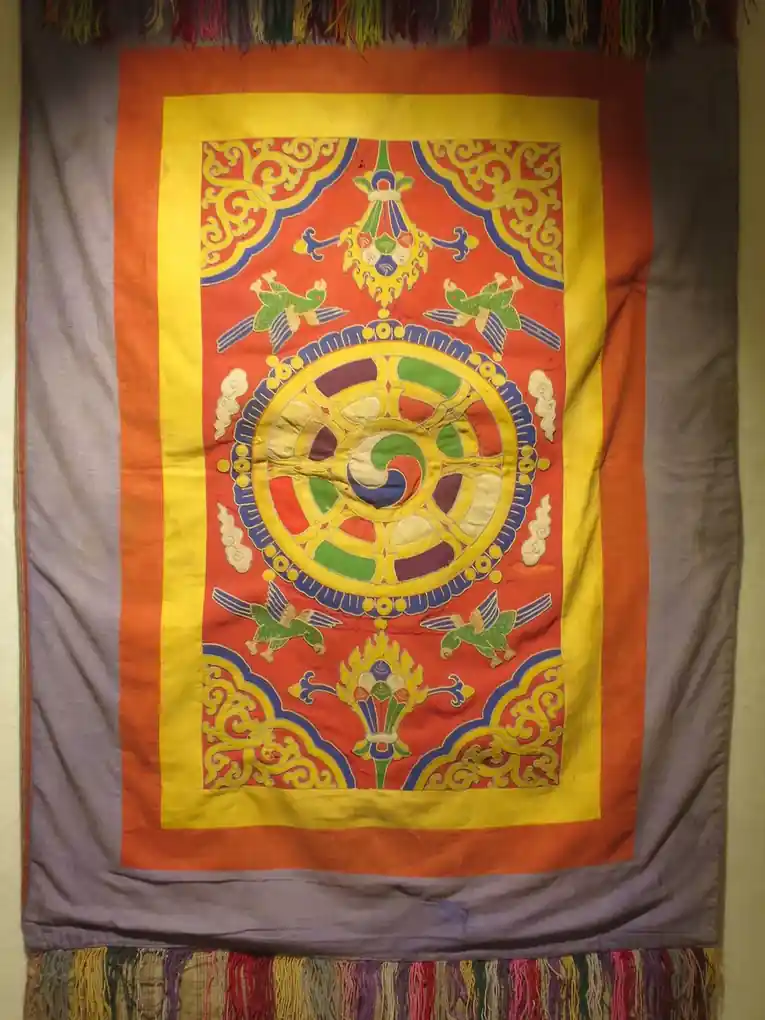
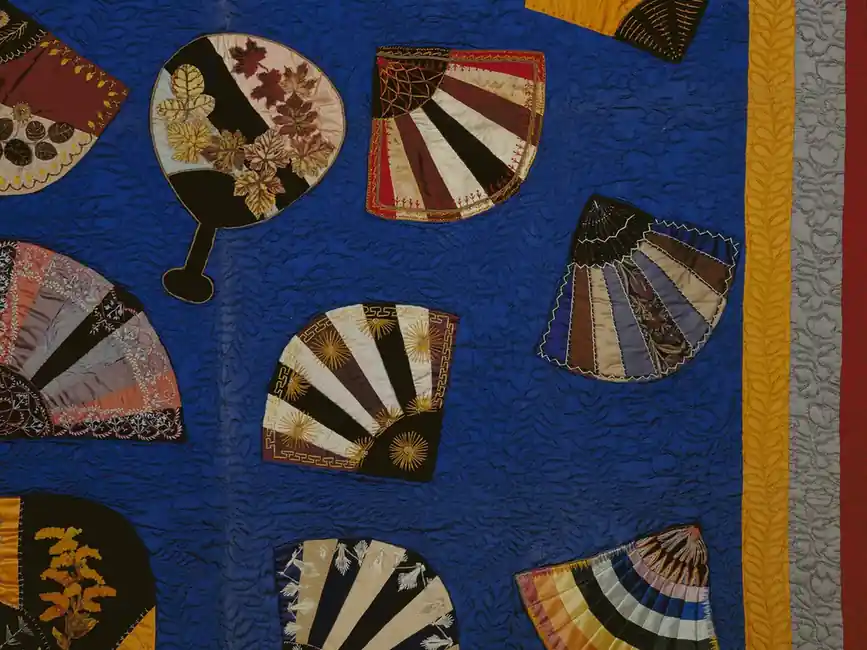
Khayamiya is the appliqué of the tentmakers: shapes cut from coloured cotton, laid on a plain ground and sewn down by hand with stitches so small they nearly vanish. Our panels are made to hang on a wall like a painting, and come in two sizes.
Layers of cotton, cut and turned
A panel starts with a drawing at full size on paper. The drawing is pricked along its lines and dusted with chalk through the holes onto a heavy cotton backing, which leaves a dotted guide on the cloth. Then the colour goes on in layers. The largest shapes are cut first from plain-dyed cotton, pinned in place, and their raw edges turned under with the point of the needle as the stitching goes along. Smaller shapes are laid on top of those, and smaller still on top of them, so that a lotus might be four layers deep at its centre.
The stitch is the tentmakers' stitch: a short, close hem stitch worked in a thread matched to the top layer, so that from a little way off the edges look painted rather than sewn. A 60 × 60 cm panel holds many hundreds of these stitches; the large panel holds several thousand. There is no machine seam on the face of either, and no glue or fusible web holding anything down.
When the face is done, the panel is backed with a second cotton layer, edged with a narrow binding and given a sleeve across the top for hanging. It is pressed from the back under a cloth, rolled around a card tube and wrapped for the crate, never folded.
Geometric, lotus and arabesque
Star geometry
Eight-point stars locked into a grid of crosses and hexagons, in two or three strong colours. Crisp at a distance and the most architectural of the three.
Lotus
A central lotus opening upward, with curling stems and smaller buds in the corners. Usually worked in warm reds, ochre and teal on a cream ground.
Arabesque
Endless interlaced scrolls and split leaves running edge to edge, with a narrow border. Quieter, and the one that looks most at home behind a sofa or a bed.
Tell us which motif you want in the message box on the order form. If the colour of a panel matters for a particular room, say so, and we will send a photograph of the actual panel before asking for payment.
Two panel sizes
- Khayamiya panel, 60 × 60 cmHand-stitched cotton appliqué, rod sleeve$145
- Khayamiya panel, 100 × 150 cmHand-stitched cotton appliqué, rod sleeve$390
60 × 60 cm, $145. A single motif — usually a star medallion or a lotus — with a border on all four sides. It fits above a console or a desk, or in a pair either side of a doorway. The sleeve takes a rod up to 15 mm thick.
100 × 150 cm, $390. Hung in portrait or landscape, this is a wall's worth of work, with a central field, corner pieces and a double border. It is the size to use when a panel is the main thing in the room. The sleeve takes a rod up to 20 mm.
These are the only two sizes. Our backing cloth, binding and templates are cut for them, and a panel made to any other measurement would be a new design with costs we cannot predict. If neither size fills a wall, two or three small panels hung in a row usually look better than one stretched pattern.
Hanging the panel and keeping its colours bright
Each panel has a cloth sleeve stitched across the back of the top edge. Slide a wooden dowel or a slim curtain rod through it, rest the rod on two hooks or a pair of brackets, and the cloth hangs straight from its own weight. We do not send the rod or the hooks, and we do not hang panels for anyone; any hardware shop will have what you need for a rod of the stated thickness.
Cotton dyes fade in strong sun. Hang the panel where daylight does not fall on it directly for hours at a time, and it will keep its colour for many years. A wall opposite a window is fine; a wall that faces into the afternoon sun through bare glass is not.
To clean, take the panel down, lay it flat and use a soft brush or a vacuum with a gauze over the nozzle, working from the centre outwards. Do not wash it in a machine: the layers shrink at different rates and the edges pucker. If a mark needs attention, dab it with a damp white cloth and cold water, never rub, and let it dry flat in the shade.
If you store a panel, roll it face out around a tube with a sheet of plain cotton between the turns. Folding leaves creases along the appliqué edges that are slow to relax.